


Style
Type
Still
Winemaker
Sébastien Pineau
Appellation
Haut-Medoc
Varieties
Cabernet Franc, Cabernet Sauvignon, Merlot, Petit Verdot
Farming
Organic
Ratings & Reviews
Vineyard
Before the 1855 Bordeaux Classification, Saint-Seurin, along with Pauillac, St-Julien, and Margaux, was classified as a First Growth in the 1974 Intendant du Guyenne classification, underscoring the historical value of its soils for vineyards. Saint-Seurin is located where the Gironde River bends due to a limestone embankment. Today, despite its rich history, Charmail labels its wines as Haut-Médoc instead of Saint-Seurin, similar to its neighbor Château Sociando-Mallet. The best soils in Saint-Seurin are a continuation of St-Estèphe, consisting of gravel and clayey limestone. Charmail’s inclusion in the World Atlas of Wine under the St-Estèphe page highlights its importance. Charmail's vineyard plots have been mapped and matched to grape varieties since medieval times. Historical records from 1709 show that most of the current vineyard plots were already planted with vines. Charmail grows Cabernet Sauvignon on silicate gravel soils from the Pyrenees, which are well-drained and contribute to the wine's structure. Merlot is grown on red clay colluvium soils, which retain water and add acidity, while the iron in the soil gives the wine savory, almost salty notes. The Merlot's freshness makes it a good pairing with dishes like canard à l’orange.
Vinification
Destemming, soft infusion of must for 24 days where grapes ‘crushed’ by their own weight; fermentation continues for another 12 days, with some CO2 used to gently break the cap. Soft press and then élevage for 12 months: 95% in large wood demi-muids (500 liters) and 5% in 17HL cement eggs (Nomblot).
Features
Cork
Available Sizes (L)
0.750
Distribution Area
New Jersey and New York
Shelf Talkers
Tech Sheets

Offerings from Château Charmail
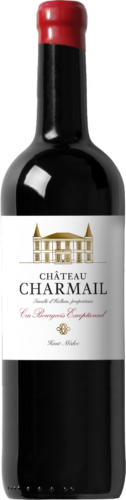
Haut-Médoc Cru Bourgeois Exceptionnel
2 Commerce Dr. Suite 3 Moorestown, NJ 08057
Office 800.245.0184
Fax 856.985.5848


