


Weather a Challenge for Italy’s Growers
The harvest is coming in early after a brutal heatwave caused grapes to ripen well ahead of schedule.
By Tom Hyland | Posted Monday, 18-Sep-2017
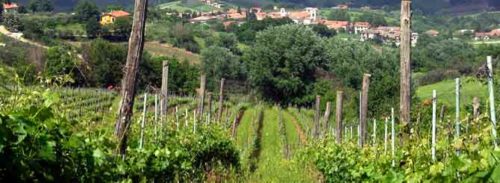
The vineyards of Greco di Tufo are already being picked, as heat brought the harvest forward.
The grape harvest is well underway throughout Italy’s wine regions, and to label this year’s crop as challenging would be a major understatement.
Torrid heat and a serious drought (especially in the north) have combined to bring about intense grapes, most of which are being picked two to three weeks ahead of schedule. Thankfully, some recent rains helped slow things down so, while 2017 may not be an outstanding vintage, it certainly will be better than the disaster some had predicted only a month ago.
The region of Piedmont offers an apt analysis of this year’s unusual growing season, as Stefano Chiarlo, winemaker for Michele Chiarlo, can explain. He notes that after a very mild winter with not much snow, vegetation started a bit early in March, which was followed by cold, windy days in April. A good amount of rain fell in April and May, but from June until early September, it was a long, hot summer, especially in the province of Asti, which affected growth of Barbera and Moscato in that zone.
Hail, always a threat in Piedmont, hit the commune of Neive in the Barbaresco production zone, quite hard in April. Valter Fissore, winemaker at Elvio Cogno, reported that he lost 40 percent of his Nebbiolo at the Bordini cru in Neive; other vintners in this locations suffered even higher percentages of damaged vines.
Drought conditions were a key factor in understanding this year’s growing season in Piedmont, as Andrea Roccione of Scarpa winery in Nizza Monferrato explained. “The 2017 harvest comes after two vintages, 2015 and 2016, that were also quite dry. The water reservoir from 2014, a rainy year, had run out after the past two years. So this vintage has been particularly complicated because of that.”
Combine that with extreme heat – this June was the hottest on record in Piedmont – and you have accelerated growth in the vineyards, resulting in lower acidity, as well as a loss in varietal aromatics. “In order to survive, the vines have started to suck their own pulp,” says Roccione. “So what you get from the vine are dried-out grapes that are highly concentrated, but also a very poor harvest, because you don’t get much out of the vine.”
Thankfully, about two inches of rain fell throughout much of Piedmont on September 1, the first precipitation in some areas in almost two months. Temperatures, which had been more than 100 degrees the last few days of August, dropped to a more typical range of high 70s to low 80s, allowing for at least a slight delay in ripening. Harvest did start the last week of August, with Moscato and then some Dolcetto; both varieties were being picked at the Poderi Colla estate in Barbaresco on August 29. Proprietor Tino Colla seemed pleased with this initial crop, stating that “regarding acidity, it will not be too high, obviously, but it will not be too low either”.
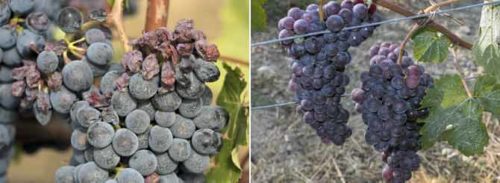
A measure of the inconsistent weather: sunburnt Barbera in Asti (L) contrasts with healthy Nebbiolo in the Cannubi vineyard.
Most varieties in Piedmont will be harvested two to three weeks early; Chiarlo confirms that he will pick Nebbiolo in the Barolo area in mid-September, three weeks early. “It could be like 2011, having some similiarities,” remarks Chiarlo, referring to a recent warm growing season. “This is a vintage with very low yields,” he says; for the producer, he will have 30 percent less Barbera and Moscato to work with this year, as he has had to drop a good amount of crop to enable the best quality he can generate this year.
In Tuscany, winemaker Barbara Widmer at Brancaia in the village of Radda in Chianti notes that she started harvest in the coastal Maremma zone on August 14; this was for Merlot to be made as a rosé, while she picked Sauvignon Blanc grapes in Chianti in the last week of August. “Both of these were one to two weeks earlier than normal,” she says. She still has to pick some of the Sangiovese and Cabernet Sauvignon in her Chianti Classico vineyards, while Cabernet Sauvignon, Petit Verdot and Cabernet Franc remain to be picked in the Maremma; she predicts that everything will be in the cellar around the 20th or 21st of September. Does she have a conjecture for her 2017 wines? “There is some outstanding quality fruit, but the large percentage will be of average quality.”
Axel Heinz, winemaker at Ornellaia in Bolgheri, near the Tyrhennian Sea in northern Tuscany, commented: “2017 has been an unusually early year dominated by a long-lasting drought period that has forced us to start harvest two weeks earlier than usual. It is certainly a challenging year with a very small crop and very concentrated fruit.” He noted that some rain finally came in early September before the late-ripening varieties (Cabernet Sauvignon, Petit Verdot) were to be picked.
In Soave, Chiara Coffele, reports that she has not started harvest yet, but will starting this week, two weeks early, compared to other vintages. “Garganega is a late-ripening grape, she says, “so it needs a bit more time. Furthermore, we wanted to wait for a bit of rain – which did come – in order for it to be able to reach its perfect maturation.”
In the southwestern region of Campania, Antonio Capaldo of Fuedi di San Gregorio noted “a significant decrease in quantity [about 40 percent on average, he estimated], but I hope it can be a good vintage for quality”. He reported a gentle rain falling last week along with cooler weather, so “the maturation is coming more gently than in other regions where the heat was crazy”.
Piero Mastroberardino, proprietor of the celebrated Campanian estate, said that while the summer was dry with higher than average temperatures, “only a few weeks were hot”. This will result in low yields, less grapes than average with small berries, he surmised.
Mastroberardino has positive thoughts on his 2017 crop. “We benefit from a late maturation period in our area, as compared with other parts of the country. About the time schedule, we will probably start picking the white grapes about 7-10 days earlier than average, while for Aglianico, we will probably start in mid-October.
“Grapes are very healthy, so expect very good quality and an extraordinary vintage for Aglianico grapes.”

