


October 19, 2017
Exclusive: Sparkling Wine Driving Industry Growth In 2017

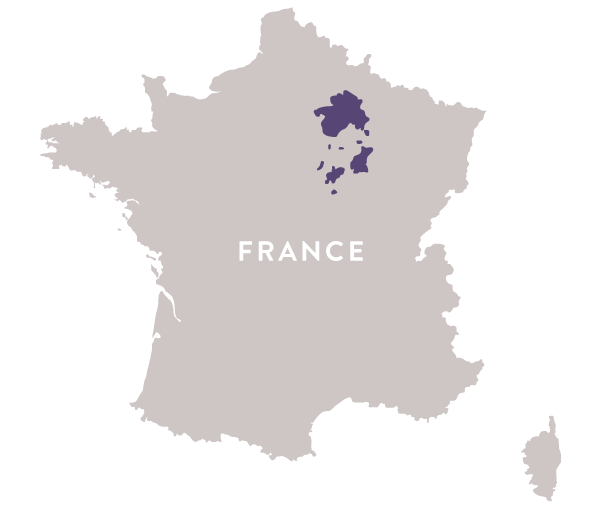
The Mathieu family
Isabelle and Michel Mathieu-Jacob
Champagne
Delaware, New Jersey, New York, and Pennsylvania
Pinot Noir
The vineyards of Serge Mathieu are 80% Pinot Noir and 20% Chardonnay. The vines have an average age of 23 years.
The main vineyard, adjacent to the winery and office, is called La Bressoire. It covers three hectares in a single block. Its steep slope faces south southeast and is planted exclusively with Pinot Noir.
A second series of fifteen plots lie on the slope called Bagneux, which is planted with both Pinot Noir and Chardonnay. The vines lie at the top of this slope where they are less susceptible to frost. The remaining part of the estate is comprised of four long strips on the hill called Couins.
Sustainable

The Mathieu family has lived in Avirey-Lingey since at least the 18th century. In 1760, then again in 1860 and 1894, notarized deeds show that plots within the commune of Avirey-Lingey were acquired by the Mathieus. Seven generations of vine-growers have now managed the estate, at first selling their grapes to négociant houses. In 1958, Serge Mathieu started to work on the estate with his father. As sales of Champagne grew, he produced his first bottles in 1970. From an initial level of 5,000 bottles per year, production rapidly increased to 40,000 bottles, most of which were at the time sold in France.
In 1987, Serge’s daughter Isabelle joined the family firm after studying modern languages at university. She soon set out on the road to France, Germany and then Great Britain, making contacts and rapidly extending their clientele. Within the space of a dozen years, sales grew to over 80,000 bottles, of which 60% were exported — a very large percentage for a small grower.
In 1996, Isabelle married Michel Jacob, a vine-grower from the nearby village of Merrey-sur-Arce. He joined the Mathieu family business a couple of years later and decided to focus on the vineyards and their care. In the cellar, Serge tutored the young recruit and gradually handed over the reins. Isabelle and Michel energetically handle the four main jobs of an independent wine-producer (vineyard cultivation, winemaking, selling and administration).
The village of Avirey-Lingey is one of the smallest wine-growing communes in the Aube. On the face of things, there have been few changes in the small village if one is to judge by comparing photographs taken in the early 20th century with today. The village still lies huddled around its church in the valley hollow, with vines climbing up the surrounding hills. And yet, despite this apparent immobility, this part of Champagne has witnessed a revolution over the past century. Progressive changes have seen growers fight to remain part of the Champagne appellation, then gradually earn the confidence of the major Champagne houses from the Marne for the quality of their grapes. And now they increasingly make and sell their own Champagnes. The Mathieu family have been involved in every step of these changes.
Pinot Noir accounts for 89% of vines planted in the region. Specific soil types, local climate conditions, slope and orientation are extremely varied, producing separate meso-climates. Each vine-grower needs to be fully attentive to his own terroir to make the most of it. For Michel Jacob this is an absolute priority, as he has divided the estate into plots which all receive individual treatment.
For the past 20 years, Serge Mathieu established what they call vitiforestery which is planting shrubs and hedges in the vines. Their vines are covered with plants from July until April of the next year. This cover increases the biomasse of the soil and the microbial life which naturally feeds the vines. They plow the vineyards without using chemicals and hardly ever use pesticides. They were the first using UV to fight against diseases like mildew and oidium, and they are also the first in Champagne using drones to spray organic products. The winery has HVE (Haute Valeur Environnementale) certification and is working on converting to organic. They expect AB Bio Organic Certification by 2023.



2 Commerce Dr. Suite 3 Moorestown, NJ 08057
Office 800.245.0184
Fax 856.985.5848


