


November 03, 2022
In a world racked by rampant inflation, haywire logistical supply chains and a European war, Argentina looks pretty good right now. Down at the world’s end, the issues affecting industries across the globe are being taken in stride. For years, Argentine wine producers have had to deal with crisis after crisis: the climate, energy and economy. However, Argentina always finds ways to make it work through ingenuity, resilience and creative winemaking.
Since I started working on this report in July 2022, Argentina’s resilience has become increasingly apparent. I’d barely stepped through a winery’s door before the lamentations began, ranging from complaints about the exchange rate to the climate. Still, oenologists and owners would soon move on to excitedly talk about their latest projects, achievements and enthusiasm about the long-term future. It’s almost as if all that winemakers care about is getting into the barrel room or cellar to open their wines. They’ve never been particularly fazed by challenges – which, admittedly, are legion – buoyed by the knowledge that they’ve always been able to overcome them in the past. That is Argentine wine in a nutshell.
Some of the areas I visited were truly suffering. I went pretty far off the beaten track to taste more than 1,200 wines featured in this report. I traveled to the east of Mendoza, to witness the effect of years of drought for myself: abandoned vineyards and a general loss of business focus. But even here, one freezing night, I found one or two desert stars offering a twinkle of hope thanks to a new wave of young producers looking to revive the region. “We need to explore authentic flavors, to depend less on oenology and more on ideas,” winemaker Matías Morcos told me.
On my return home, I tied it all together, linking overlooked corners with up-and-coming terroirs such as Pedernal in San Juan or the highest parts of the Uco Valley. What I found is that Argentine wine is an excellent metaphor for the country’s character: here, resilience is king; everyone does the best they can with the tools at their disposal, and, sometimes, with the country’s distinctively bullet-proof optimism and plenty of ingenuity, the results can be quite brilliant.
From raw, primary reds to wines where the aging process takes center stage, whites made from red grapes, deeply rational oenological approaches and some that seem simply nuts, a fondness for both experimentation and the classics, new research and the tried and tested… it’s all part of a scene in which some bottles offer genuinely spine-tingling quality while plenty deliver superb value for money, while others are best described as eminently forgettable. In any case, in this chaotic world in which we live, drinkers will never be bored in Argentina.
The Malbec Paradox
Of the wines in this report, 478 are 100% Malbec (which is also featured in numerous blends). Malbec is clearly the variety that producers know best. There are still plenty of versions that will disappoint anyone looking for something striking or new.
It might be a good idea to adjust our gaze a little. If you start comparing different areas, the variety often takes a back seat to expressions of terroir. Drinking a Malbec from a high part of Gualtallary, which is rich in calcareous deposits, alongside one grown in similar soils but in Paraje Altamira (both of which are in the Uco Valley) can be an illuminating experience that delivers quite different textures and points of ripeness. If you continue your comparison with one from Las Compuertas in Luján de Cuyo or Pedernal in San Juan, you’ll find that the range of sensations and flavors only keeps growing. It’s not dissimilar to tasting Cabernets from different terroirs in California.
A small but intense minority of producers are going even further and achieving bewitching results. They are beginning to isolate the flavors produced by different soil types on the same property, with each vein and its associated height and exposure, adding greater nuance to the palette of flavors Malbec is capable of. When done well, this can be an extremely virtuous circle. Look out for terms on the label such as parcel, polygon, island or pocket, all of which indicate that such approaches are being taken. They might well lead you to rich but fresh and juicy Malbecs such as the 2019 Gran Reserva Altocedro, 2020 Catena Nicasia Vineyard or 2019 Terrazas de Los Andes Parcel N12S Licán, or, on the other side of the scale, skinny, vibrant incarnations such as the 2019 Zuccardi Piedra Infinita Supercal or 2019 Per Se Iubileus.
Malbec presents quite the paradox: it’s a safe bet for consumers with an ample comfort zone (especially in Luján de Cuyo, on which I’ll be doing a Terroir in Focus at the end of the year), but it can also be quite an adventure. To orient yourself, keep an eye on the stylistic records of specific regions and producers.
Los Chacayes, an Emerging Region
One of several areas on the rise, Los Chacayes in the Uco Valley boasts multiple virtues that put the location at the front of the pack. Los Chacayes is the home of several successful real estate ventures such as The Vines, Casa de Uco, Alpasión and Los Arbolitos; while in the northern half the Clos de los Siete estate, almost 300 hectares, also falls within the region. To date, this Geographical Indication contains 1,000 hectares under vine at the height of 3,200 to 5,600 feet in poor, stony soils.
Los Chacayes is an area where real estate ventures cover lots between half to two hectares on average, resulting in the presence of many small producers. The approval of Geographic Indication status in 2017 was an essential step for the region. At the time of writing, about 100 wines are officially declared from Los Chacayes. The area is increasingly in the mouth of the industry. In addition to the producers mentioned above, Corazón del Sol, Piedra Negra and Ver Sacrum are all bottling a diverse range of well-made wines.
Outside the Box
Beyond its traditional redoubt of Malbec, Argentina offers plenty more flavors. There is an exciting, current trend of making pure Cabernet Francs, of which I tried about a hundred for this report. The first Cabernet Franc clones were planted in the 1990s. To date, about 1,600 hectares are under vine (+300 hectares since my latest report). Where many of the wines from Argentina go heavy on fruity flavor, Cabernet Francs offer more herbal and ashy components combined with palate-cleansing freshness. These qualities are advantageous when blended with Malbec: the fruit and generous palate of the latter goes very well with Cabernet Franc’s herbal qualities and stricter character, striking a balance that will rarely let you down.
2020, a Watershed for Cabernet
Before COVID, BC and AD were the most used terms to describe different ages. Now everything is pre- or post-pandemic. Said dividing line falls precisely upon the 2020 harvest, which proved to be the end of a warm, dry season complicated by the uncertainties of the quarantine. But there were several lessons to be learned from the experience; one of the most interesting involved the early harvest of Cabernet Sauvignon.
In Argentina, the received wisdom had been that Cabernet Sauvignon “holds out well” on the plant, which is why wineries tended to leave it until last, losing depth and nuance in the process. But, amid the uncertainty of the pandemic, several wineries harvested it in early March, a month earlier than usual, in some cases before the Malbec. The results, when accompanied by well-thought-out winemaking, are striking. This is true of the 2020 Teho, 2020 Mariflor, 2020 Catalpa, 2020 Catena Alta, 2020 Escorihuela Limited Production and 2020 Susana Balbo Limited Edition Los Chacayes, all of which are full of energy with precise, fruity flavors.
While a good number of reds ended up with an alcoholic core, the 2020 Cabernets achieved a balance in which the fruit comes out more clearly and the tannins are refined (if appropriately extracted). This early harvest appears to have been repeated in 2021 and 2022, saving many from the unusual frost that struck between the 29th and 30th of March 2022. We will be talking about pre- and post-pandemic Cabernets in the future.
In Search of Elegance
One cold, leaden-skied morning last July, I visited Bodega Tapiz in San Pablo, Uco Valley. Just a few miles away, the snow was falling on the mountains. My last visit there was in 2019, when when I first met Jean-Claude Berrouet – a key figure at Pétrus since the 1960s – who was there in an advisory role. We enjoyed a fascinating conversation about the search for elegance and balance in cellar wines. Berrouet said something that seems especially relevant to what is going on in the Uco Valley today: “The only tannins that last a long time are balanced from the start.”
This year, Fabián Valenzuela, the oenologist at Bodega Tapiz since 2004, joined me for a tasting during which this concept rang through loud and clear in several of the glasses, most especially the one filled with 2018 Las Notas de Jean-Claude. Derived from precise, detailed work, the wines were truly impressive.
The issue with high-altitude vineyards in Argentina (the Uco Valley is planted from 3,200 feet and up) is that the wines are naturally intense and energetic. Combined with a firm structure and tannins, they tend to have a raw character that needs polishing through well-judged harvest times, precise extraction and shrewd aging. Only then can their elegance come to the fore, something that isn’t just a matter of enhancing an already intense regional character, but finding a balance that allows the subtle details to flourish. Berrouet and I talked about this several years ago when he explained the approach he took in Pomerol back in the 1970s. I’ve had many similar conversations with Alejandro Vigil, who heads up Catena Zapata, Matías Riccitelli from the eponymous winery, Alejandro Sejanovich at Teho and Hans Vinding Diers at Noemía. Achieving elegance is the true challenge of high-altitude wines. In this report, a handful of producers have managed to obtain it, establishing a rich new vein of polished energy that seems to get bigger every year.
Raw Dogma
One of the most eye-catching trends of recent years has been the emergence of raw or bare reds. Like the Danish Dogme 95 film movement, the style is founded on the premise that one can strip everything down to its barest essentials. Applied to wine, this means doing without oak – or at least refraining from fine-tuning it – and ensuring that the expression is as elemental as possible to bring out the character of the grape and the region. Hence the term raw or bare. The success in recent years has provided fruitful new terrain for these reds.
The combination of high-altitude vineyards and areas with a cooler climate is propitious for this style, examples of which come from Familia Zuccardi, perhaps leading the way alongside Riccitelli Wines, Altos Las Hormigas, SuperUco, Magna Montis and Finca Suárez. Of course, they aren’t the only ones, but because this approach involves a commitment to freedom and low intervention, rawness is inevitable – for better or worse. Good examples include 2021 Malbec Zuccardi Concreto, 2020 Cabernet Franc SuperUco Calcáreo and 2019 Malbec Riccitelli Viñas Extremas Los Chacayes, all of which are skeletal with the barest whisper of flesh and compellingly, vibrantly raw. To a degree, they’re the antithesis of the rich, opulent wines found elsewhere—a little like the difference between Danish Dogme and industrial cinema.
The Far East
Whenever people talk about the glory days of the Argentine wine industry, they mean the east of Mendoza. This is a region set between 1,600 and 2,300 feet above sea level in a desert about 90 miles to the east of the capital city. The soils here are deep with high temperatures in summer, which is why it is so well-suited to mass production. Of all the surface area under vine in Mendoza (149,000 hectares), the east accounts for 42%, but it doesn’t figure on the fine wine map.
As consumers shifted from drinking wine every day to view it as more of a special occasion drink (from 93 liters a year per person in the 1970s to 21 today) and the export markets preferred reds of greater depth, producers from the east began to disappear. Achieving concentration, tannins and structure isn’t possible here. But the biggest challenge is preserving acidity.
That is what makes current developments so interesting. I spent a day tasting wines made by several producers determined to rouse the east from a slumber that began in the 1980s. Some of their approaches are very interesting. For one thing, this is a region of heritage wines. Some of the older mixed plantations today function as genetic archives.
An extreme example can be found at Niven Wines: “Here, we harvest by plant, not row,” Lucas Niven once told me, showing me a printout in which every vine is marked: one row contains Criolla Chica, Grande, Canela, Maticha and Bequignol, among others that are yet to be identified, all of which were registered officially as Tempranillo. Niven shared, “It took us about three years to understand what we had in this lot. We don’t know when it was planted, but it’s been in the land record since the 1920s.” Niven is working to restore these varieties, and his blends might light the touch paper for the rest of the east. His vineyard isn’t an exception by any means, but it is one of the most heavily studied. Promising wines from this work include his 2022 Criolla Argentina Rosado de Rosadas and 2021 Criolla Argentina Canela, both of which will please those with exotic tastes.
Meanwhile, producers like Matías Morcos want to produce wines of volume that reflect new concepts. “I like to combine Criolla grapes with Bonarda to achieve a light, fruity red,” he told me during our tasting. Now he’s looking to revive some of the Italian varieties planted to the east, such as Lambrusco and a little Sangiovese, to bring greater freshness to his wines. Macollo is working along similar lines, focusing on greater freshness; both are young houses interested in creating brand-new flavor palettes.
Bonarda – better known elsewhere as Corbeau, Charbono or Douce Noir – is extensively planted in the area. This is a productive, fruity variety that offers very little tension; not quite satisfying enough to be thirst-quenching and too skinny to be potent. However, in specific pockets of soil, interesting things are showing up. El Enemigo Single Vineyard Bonarda achieves greater depth, as do the 2021 Pala Corazón Bonarda and 2021 Catena Zapata Vino Natural La Marchigiana Bonarda, all of which are the result of these new approaches.
Identifying a viable style will be critical to reviving a region that already boasts a wide array of grapes and the potential for excellent yields. While the team at Niven continues its quest to find the Philosopher’s Stone in their vineyards, the National Institute of Agricultural Technology is in the middle of its own search to fill in the family tree for Criolla varieties, the handful of grapes native to Argentina. Some are widely planted in the east, including Cereza (a Rosé with 13,000 hectares), Pedro Giménez (white, no relation to the Spanish variety, of which 7 million hectares are planted in the area) and Criolla Grande (another Rosé with 12,000 hectares under vine). A handful of producers are experimenting with them, with mixed results so far. Pedro Giménez looks most promising but requires aging, biological or in barrels, to fill out properly. The 2019 Cephas offers a good idea of what’s been achieved so far.
One Country, Two Speeds
Argentina is a modern country in some ways and backward in others; this applies to wine just as much as anywhere else. Where producers are doing well in the domestic or export markets, regions become hotbeds of experimentation, new styles and modern approaches. Where they aren’t, none of that applies, for instance, to the east of Mendoza.
An example of the latter is the Province of San Juan, which has the second most surface area under vine after Mendoza at 43,500 hectares, a fifth of all the vines in Argentina. However, 95% of these are planted in warm areas, with high yields similar to the east of Mendoza. Nonetheless, a few mountain valleys deserve our attention: Pedernal and Calingasta are head and shoulders above the rest of the province.
Pedernal is set in the Andean foothills at 4,900 feet above sea level. Its geology is especially relevant: in contrast to other Argentine terroirs, one of the sides of the valley, known as the Sierra de Pedernal, is made up of a unique kind of calcareous rock. Half the valley has this soil, while the other half is classically alluvial. Pedernal contains 850 hectares planted using modern techniques by large wineries and investors from the 1990s onward. Malbec from the region has a unique character: an aromatic profile of open fields, violets and resin; it’s juicy in the mouth, with tart freshness. Good examples include 2019 Pyros Limestone Hill, 2021 BenMarco Sin Límites Pedernal and 2017 La Linterna Finca La Yesca Parcela 13.
Meanwhile, the Calingasta Valley is a large plateau closed off by two ridges that rise to 13,000 and 16,000 feet respectively. Twisting through it like a rosary is the Río Los Patos, which provides the water for several sleepy Andean towns and 200 hectares of pergola and double cordon vineyards. Far from worrying about their isolation, a group of small producers considers the place a unique terroir. Cara Sur focuses on Criolla varieties, Cambachas on more classical styles and Los Dragones on bare, direct fruitiness, revealing the quality of the grapes to be had in this corner of the Andes.
Small Producers
An entrepreneurial impulse often accompanies the resilient spirit that typifies Argentine wine. For this report, I tried wines from about 30 small producers: some have formed groups, such as Los Productores Amigos (Producer Friends), that oversee the business side, while others do it entirely alone. Tasting with these almost always one-person entities offers a refreshing new perspective on wine. Over time, some of them have even managed to establish their own style. In that regard, it’s worth checking out: Oíd Mortal, which produces vivacious wines with refined, fruity flavor; Entrevero, whose output is more opulent; and Lui, where the emphasis is on lightness and intensity.
2023 and Beyond
While the world’s future still seems uncertain (the IMF predicts that at least a third of the globe will be plunged into recession in 2023), the outlook in Argentina is even gloomier. The wine scene may be resilient and creative, but the gathering of dark clouds will test those qualities. One significant challenge is the exchange rate imposed upon exporters, which is significantly less favorable than the market rate. Wineries are seeing their margins wiped out by inflation, which will run at 100% in 2022 – it’s been 50% for the past few years and 35% for the past decade. Keeping up a supply overseas is thus a long-term bet that not everyone is willing to take. The devaluation of the Argentine Peso (there are at least a dozen rates, both official and unofficial, between the highest, which is around 300 to the dollar, and the official one, which is 150) is only going to get more challenging to resolve. What’s good for exporters is likely to hurt the poorest in society, and the poverty rate was already 36.5% in August 2022.
Focusing on the wine business alone, 2021 saw exports to the United States rise again after steady falls in previous years (+9.8% in income compared to 2020). Two thousand and twenty-two looked to be going similarly in August when the last available data were published.
Overall, Argentina offers a rich and varied panorama, revealing unsuspected new facets and styles.
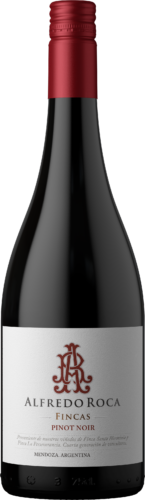
2021 Pinot Noir Fincas
90 points
The 2021 Pinot Noir Fincas is cherry red in the glass. On the nose, sweet and
sour cherry, hints of earth and subtle mushroom notes appear. Quite smooth in
texture and fairly ripe with a little grip, this a voluminous wine for the variety.
The 13.2% alcohol is unusual in the region.
Click here to read the original article
Click here to learn more about Alfredo Roca

