


Back For More Beaujolais
BY NEAL MARTIN | AUGUST 26, 2021
My first foray into Beaujolais was not writing about it, but shipping it from one side of the world to the other. Mea culpa: I played my part in the not-so-carbon-neutral tradition of freighting jumbo jets full of Beaujolais Nouveau to Japan every third Thursday in November. Fortunately, I was never asked to dive into a swimming pool foaming with Gamay. I just had to get it there on the dot.
Back then, Beaujolais Nouveau defined the region. But there was another side to Beaujolais, inspired by the work of Jules Chauvet, which gestated a counter-movement of terroir-driven, low-intervention and sulfur-free wines, often made according to organic or biodynamic principles. Beaujolais was ahead of the game as these tenets spread around the world. To this day, the region remains home to both high-volume, commercially minded producers and tiny artisan winemakers.
During my six weeks in France this June, I spent three days in Beaujolais to assist my colleague Josh Raynolds, who was unable to travel during lockdown. He sent me a list of producers likely to be absent from his report, and I did my best to fill in the gaps. The organizational body InterBeaujolais did a sterling job of arranging a professional tasting in Villefranche-sur-Saône, and then afternoons were spent visiting growers. So, readers should treat this as a supplementary report aimed at providing the widest coverage possible.
I must admit that initially I was tentative about adding to an already intense workload. Did I want to take on more? I was still decompressing from three weeks of tasting in Bordeaux, not to mention all the driving. But you can guess what happened!
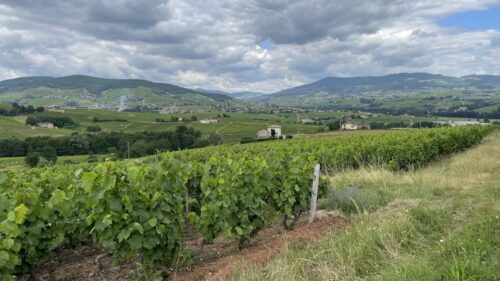
Looking south from the hills near Morgon.
As soon as I set eyes on its verdant rolling hills and began conversing with winemakers, as soon as I delved into the local cuisine and drank the wines, I fell head over heels in love with Beaujolais, like an old flame walking back into my life. There is a heart-warming sense of simplicity here that is becoming a rare commodity. Whereas the Côte d’Or fights to retain its spirit as corporations buy the choicest cuts of vineyard and its wines become unaffordable to its loyal followers, Beaujolais finds itself unburdened with inheritance or tax issues, nor does it witness generations of family ownership snuffed out by the cursory wave of a checkbook. Its wines uphold their raison d’être of being drunk and savored, not misappropriated as investment vehicles. That might change as the standard of Beaujolais achieves new heights, but today the region offers more and more outstanding wines at a level of affordability that is winning fans, consumers, sommeliers and merchants alike. Sure, there is a hipster element to Beaujolais that occasionally seems to take prominence over the cardinal rule that wine must be fault-free and delicious irrespective of philosophy. Even though, given the brevity of my trip, I could only take a snapshot, it was patently clear that Beaujolais remains a dynamic region with much to offer.
I am going to broach my findings by appellation.
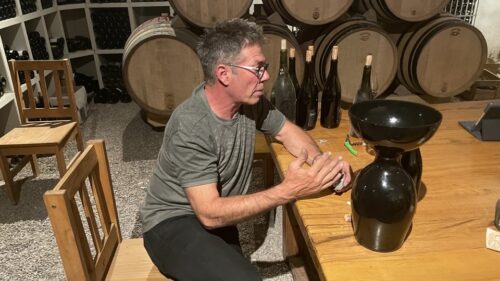
Jean-Marc Burgaud, among the best winemakers not just in Morgon, but in Beaujolais.
Morgon
The strong Morgon appellation at my InterBeaujolais tasting served up some really superb wines: the floral 2018 Morgon Charmes from Olivière & Alexis Depardon and a showy yet controlled 2019 Morgon Corcelette from Grégoire Hoppenot and Domaine Striffling. Where Morgon fell short was in terms of the bunches being picked too late, resulting in some overripe characteristics, more evident in the 2018s that I tasted than in the 2019s.
Returning to Beaujolais, I had to call in at one of the region’s best winemakers, Jean-Marc Burgaud. I have adored Burgaud’s wines since my first foray into Morgon. If anything, Burgaud is fine-tuning his craft, as evidenced by the fabulous showing of his 2020s. “We had 25mm of rain in Lantignié but nothing in Morgon,” he told me as we settled down for a lengthy tasting in his barrel cellar. “That gave me very good maturity in difficult soils. The Beaujolais Village has just 12.8° alcohol with perfect skins. Sulfur was only used after the malolactic in order to have 15-20mg/L of free SO2 and 50-60mg total SO2.”
I would serve one of Burgaud’s Morgon wines to anyone unconvinced that Beaujolais can make world-class wine. He just has that “touch.” Consistency runs through his range, although his Morgon Côte du Py is blessed with je ne sais quoi and, as proven by my recent “Mature Burgundy” piece, inbuilt longevity. Burgaud told me that one of his importers tried to persuade him to bottle his parcels separately, but I agree with him: the blend is greater than the sum of its parts. However, he does make a special cuvée under the title of “James” from a small parcel close to the cross at the summit that is only produced in the finest growing seasons. His mineral-driven 2019 shimmered with nascent energy and should age well over the next couple of decades. The good news is that Burgaud has just purchased another hectare in La Coucelette. I cannot wait to see what he can conjure from this propitious vineyard.
Click here to read the original article

