


In 1976, American winemakers bested their French counterparts at the Judgment of Paris. It’s truly remarkable how much progress American wine has made since then.
By Eric Asimov
May 18, 2026
Fifty years ago this month, the perception of American wines around the world changed forever.
It was in Paris on May 24, 1976, when nine French judges assembled at the Intercontinental Hotel for a blind tasting of 20 wines, six reds and six whites from California, four reds from Bordeaux and four whites from Burgundy.
It was not expected to be a fair fight. The judges, and everyone else, assumed the California wines were inferior and the French would come out on top. Instead, a stunning consensus revealed the winners to be a 1973 chardonnay from Chateau Montelena and a 1973 cabernet sauvignon from Stag’s Leap Wine Cellars, both in Napa Valley.
The shocking verdict gave the California wine industry a burst of confidence and marketers ammunition to sell the wines all over the world. In the decades since, the story of the Judgment of Paris has been told and retold. The tasting has been reenacted countless times at every anniversary, books have been written and movies made.
This year, I will leave the re-enactments and the retellings to others. I want to focus, not on that now legendary tasting, but on the truly remarkable achievements of the American wine industry in the 50 years since the Judgment of Paris. What American wine has accomplished in those few decades — a blip in the agricultural timeline that governs wine — is unrivaled.
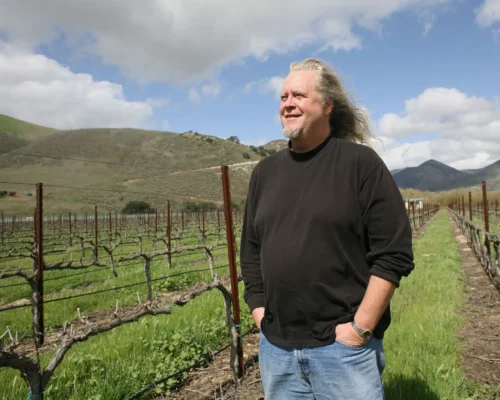
Jim Clendenen of Au Bon Climat helped set the standard for the Santa Barbara County wine region.
American wine is going through turbulent times right now. Sales are down, businesses are closing, vines are being uprooted, President Trump’s tariffs have cratered export markets, public health warnings have caused consumers to reconsider their drinking decisions and the climate crisis has wreaked havoc. Despite these obstacles, it’s inspiring to examine the bigger picture of how far American wine has come in such a short time.
In the early ’70s, Napa Valley was nothing like the luxury wine destination that now draws people from around the world. Back then, when the winning wines were made, wine grapes were among many other crops, and Napa grew more zinfandel and petite sirah than the now dominant cabernet sauvignon.
The Santa Barbara wine region was barely stirring, the Willamette Valley in Oregon was just getting started and early pioneers were just beginning to plant the Anderson Valley in Mendocino. The West Sonoma Coast, which today makes some of America’s most exciting wines, did not exist as a wine region.
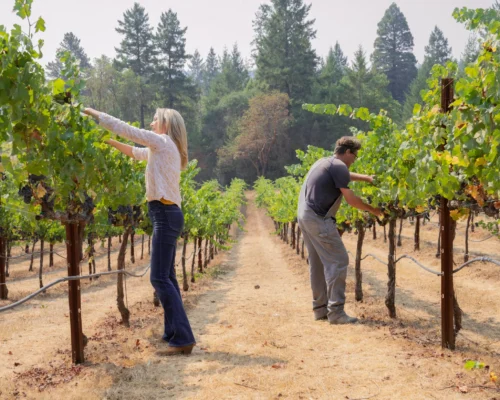
Wells Guthrie, right, who years ago stopped making big, powerful, fruit bombs in favor of classically styled wines.
Nonetheless, America was already capable of making great wines. Magnificent bottles had been produced by historic estates like Mount Eden and Ridge in the Santa Cruz Mountains, Hanzell Vineyards in the Sonoma Valley and Inglenook and Beaulieu in Napa Valley. A 1959 Inglenook cabernet sauvignon is one of the greatest wines I’ve ever tasted.
These were the exceptions. Prohibition had effectively killed a blossoming industry, and with the act’s repeal, much of the wine being made was cheap and fortified, like Thunderbird, intended for rapid inebriation, or jug wines sold with names derived from famous European regions, like Hearty Burgundy, Mountain Rhine and California Champagne. Not until 1967, in fact, did California produce more table wine than fortified wine.
But then the rocket took off. Visionary producers like Robert Mondavi in Napa Valley, Jim Clendenen of Au Bon Climat in Santa Barbara and David Lett in the Willamette Valley of Oregon saw the potential for greatness in their regions, talking the talk and making the wines to back it up.
The late 1970s and ’80s were sort of an adolescent growth spurt in which the American industry began to take shape. Slowly, what had been insular, local growing regions in America and around the world, began to communicate. American producers began to travel, to examine methods and equipment, to learn from other regions and to take that knowledge home.
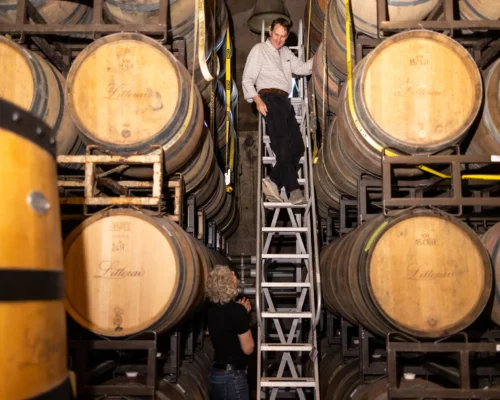
Ted and Heidi Lemon of Littorai, which makes world-class wines from the Sonoma Coast and the Anderson Valley of Mendocino.
Growing pains were obvious. It took time to understand that what worked in Burgundy or Bordeaux was not necessarily the best approach in California, or what worked in California was not appropriate for Oregon. Some wines were made with too much oak or showed too much alcohol. An entire era of over-the-top fruit bombs, peaking around the time of the 30th anniversary of the Judgment of Paris, proved to be a false start.
Many American producers never went down that path. Others, like Adam Tolmach of the Ojai Vineyard and Wells Guthrie of Copain, had conversion experiences and backed down to make more balanced, restrained, classical wines.
Second- and third-generation winemakers took over family estates or started their own. Their frames of references were not the prune and apple orchards of 1970s-era Napa and Sonoma but the wines of the world, from Jura to Sicily to Australia and South Africa. Their worldliness and understanding introduced a new dimension of diversity and refinement to American wine.
At the same time, American wine consumption was growing rapidly. By 2013, the United States had become the world’s leading wine-consuming nation, although it still trails badly in per capita wine drinking, far behind European countries and just behind Canada.
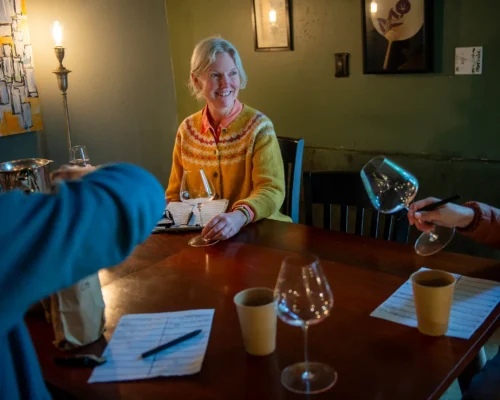
Kelley Fox of Kelley Fox Wines makes lovely chardonnays and pinot noirs from the Willamette Valley in Oregon.
Nonetheless, the rich production of the American wine industry gleams for all to see. At the highest level are wines that have achieved distinctive beauty, complexity and deliciousness, that can touch the emotions in profound ways. Think of Ridge Monte Bello cabernet sauvignons from the Santa Cruz Mountains, the pinot noirs and chardonnays of Littorai on the West Sonoma Coast, the very different but equally brilliant chardonnays and pinot noirs from Willamette Valley producers like Walter Scott, Domaine Drouhin, Antica Terra, Kelley Fox Wines and 00 Wines.
Napa Valley makes magnificent wines in many styles, whether the classic cabernets of Cathy Corison, the jewel-like wines of Bond and Harlan Estate, the more down-to-earth expressions of producers like Matthiasson and Frog’s Leap or revivals and new projects like Ink Grade and Pilcrow.
These producers are ambitious and strive for world-class wines, some earning world-class prices. But America has made great strides in making more affordable wines that are both gorgeous and accessible.
Pax Mahle in Sebastopol makes wonderful syrahs and chenin blancs that can certainly age and evolve but are also simply delicious and joyful to drink. Equally important, he’s played a mentorship role for a dozen or more excellent younger winemakers who’ve started making their own mark on the world.

Pax Mahle of Pax Wines, left, not only makes great wines, he has mentored an up-and-coming group of winemakers, including, from left, Martha Stoumen, Scott Schultz of Jolie Laide and Jaimee Motley.
Producers like Kenny Likitprakong of Hobo Wine Company and Chris Brockway of Broc Cellars have succeeded at making delicious, relatively inexpensive wines, admittedly a challenge as California is an expensive place to do business. We need more like them.
Fascinating producers stretch up and down the West Coast, like Angela Osborne of A Tribute to Grace, who makes wonderful grenache wines in Santa Barbara County, and Mikey and Gina Giugni of Scar of the Sea and Lady of the Sunshine on the San Luis Obispo Coast, part of an energetic young set bringing new life to the region.
There’s Troon Vineyard in the Applegate Valley in southern Oregon, making terrific, idiosyncratic wines, as do Nate Ready of Hiyu Wine Farm in the Columbia River Gorge and Christophe Baron of Cayuse in the Rocks District of Milton-Freewater in the Walla Walla Valley.
Far from the West Coast, the Finger Lakes of New York make the nation’s best rieslings and a thoroughly distinctive style of cool-climate cabernet francs. Virginia is coming of age, finding multiple identities for its wine, depending on what part of the state you explore. And in Vermont, Deirdre Heekin and Caleb Barber of La Garagista proved through sensitive, creative work that great wine could be made there, ushering in a re-evaluation of the potential of hybrid grapes.
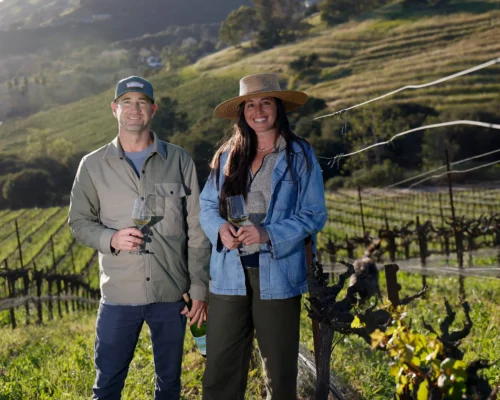
Mikey and Gina Giugni of Scar of the Sea and Lady of the Sunshine are among a group of winemakers energizing the San Luis Obispo Coast region of California.
Wherever you travel in the United States, it’s not hard to find great wine being made. It’s a tribute to the hard work and vision of an industry that’s taken its fair share of lumps. But whatever the obstacles are now, American wine is an astonishing achievement. It deserves at this moment a universal pat on the back.
And what of those wines that took part in the tasting 50 years ago? At the time, some rationalized that the young American wines were forward and obvious, and simply showed better than their French competition, which needed more time to evolve.
In the last few months, I’ve had a chance to taste two of the American wines that competed back then, the Ridge Monte Bello 1971, which finished fifth among the six red wines, and the 1973 cabernet sauvignon from Stag’s Leap Cellars, which was No. 1 among the reds.
The Ridge was a bit soft and restrained at first, befitting a 55-year-old bottle, with lovely floral aromas. With a little air in the glass, it tightened up, showing its beauty and complexity. The Stag’s Leap, too, was remarkably intact, its color turning a soft brick red at the edges, but gorgeous and complex, supple yet tense and structured.
These were great wines then, and they are great now. Today, they have a lot more company.
Click here to read the original article
Click here to learn more about Hobo Wine Company

